Combating Digital Fatigue: Fresh Content Strategies for US Journalism

Latest developments on combating digital fatigue show US online journalism organisations increasingly redesigning content strategies to improve reader retention, engagement, and long-term audience loyalty in an overcrowded digital media environment. Publishers are responding to shorter attention spans and information overload by investing in more personalised experiences, interactive storytelling formats, and mobile-first content delivery systems.
Industry analysts say many newsrooms are now prioritising concise reporting, visual journalism, newsletters, podcasts, AI-assisted recommendations, and audience segmentation strategies to help reduce reader burnout and improve retention metrics. Media executives also report growing interest in subscription models centred around trust, relevance, and community engagement rather than simply maximising page views or publishing frequency.
Readers and publishers should continue monitoring developments in artificial intelligence, platform algorithms, privacy regulations, and changing social media referral patterns throughout 2026. Experts believe the future of online journalism will increasingly depend on balancing speed, credibility, and user experience while adapting content formats to evolving reader behaviour in the United States and globally.
Understanding Digital Fatigue in US Online Journalism
Digital fatigue is not merely a transient state of boredom; it is a pervasive issue that impacts how audiences interact with online news. It manifests as a reduced capacity to process information, decreased attention spans, and an overall sense of exhaustion from constant digital stimulation.
For US online journalism, this means a direct threat to readership and subscription models, as users are more likely to abandon platforms that contribute to their cognitive overload. Addressing this phenomenon requires a strategic shift from simply publishing content to thoughtfully curating experiences.
News organisations must acknowledge that the sheer volume of available content often works against engagement, rather than for it. The challenge lies in cutting through the noise and delivering value that resonates deeply with an increasingly discerning audience.
The Imperative for Fresh Content Strategies

In a saturated digital environment, stale or repetitive content quickly loses its appeal, exacerbating digital fatigue. Fresh content strategies are no longer a luxury but a necessity for survival and growth in US online journalism.
These strategies aim to revitalise the reader experience, offering new perspectives, formats, and interactive elements that keep audiences curious and invested. The objective is to provide compelling reasons for readers to return, fostering loyalty rather than fleeting attention.
By consistently innovating, news outlets can differentiate themselves from competitors and establish a reputation for delivering high-quality, engaging journalism. This proactive approach is key to retaining a significant portion of their readership and attracting new demographics.
Personalisation and Hyper-Targeting
The era of one-size-fits-all content is rapidly fading, especially when digital fatigue content strategies are considered. Personalisation, driven by data analytics and AI, allows news organisations to tailor content experiences to individual reader preferences, increasing relevance and engagement.
Hyper-targeting takes this a step further, delivering highly specific news and features based on a user’s past consumption, location, and expressed interests. This approach ensures that readers receive content that genuinely matters to them, reducing the likelihood of information overload.
Implementing effective personalisation requires sophisticated data infrastructure and ethical considerations regarding user privacy. However, the benefits in terms of reader retention and satisfaction make it a worthwhile investment for any forward-thinking journalism outlet.
Leveraging AI for Content Customisation
Artificial intelligence plays a pivotal role in enabling advanced personalisation. AI algorithms can analyse vast amounts of user data to recommend articles, summarise complex topics, and even generate personalised newsletters.
This technology also allows newsrooms to identify emerging trends and reader interests in real-time, enabling them to adapt their content strategy proactively.
The goal is to make content discovery effortless and highly relevant for each individual reader.
Ethical Considerations in Data Utilisation
While the benefits of data-driven personalisation are clear, ethical considerations are paramount.
Transparency with readers about data collection and usage is essential to build trust and avoid alienating the audience.
- Clearly communicate data privacy policies.
- Offer opt-out options for personalised content.
- Anonymise data where possible to protect user identity.
Interactive and Immersive Storytelling
Static text and images often fall short in today’s dynamic digital environment, contributing to digital fatigue. Interactive and immersive storytelling techniques offer a powerful antidote, transforming passive consumption into active engagement.
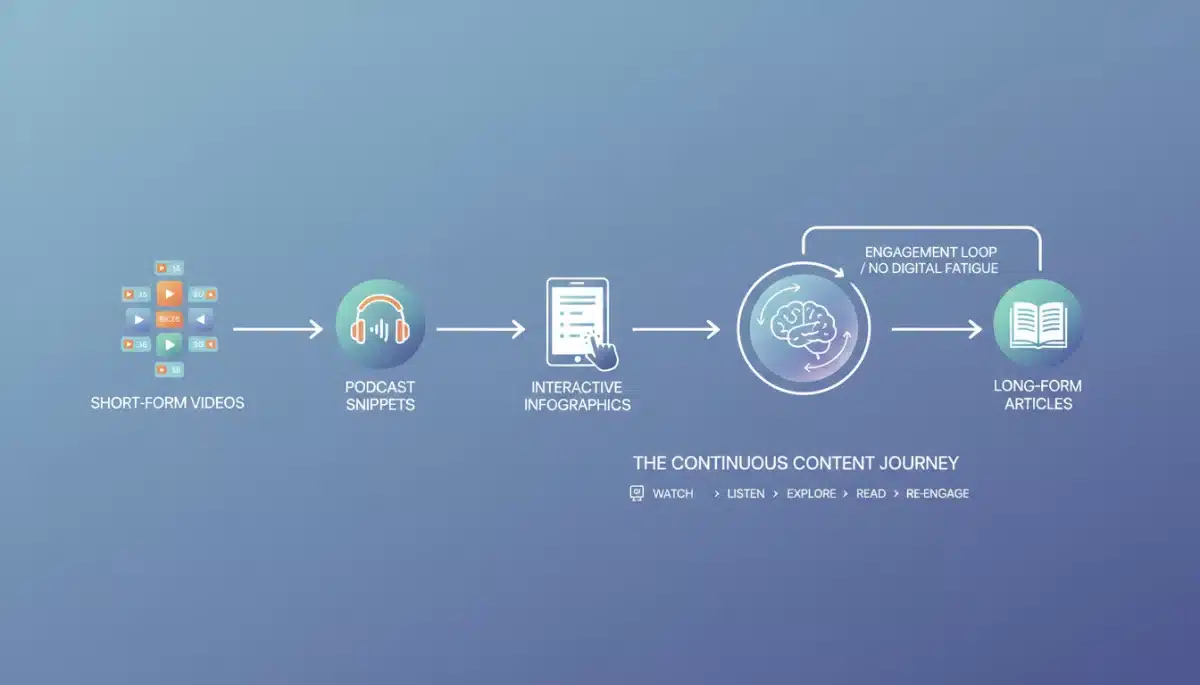
These formats include everything from interactive infographics and data visualisations to 360-degree videos and virtual reality experiences. By allowing readers to explore narratives at their own pace and from different angles, these methods create a more memorable and impactful experience.
The investment in such technologies can be substantial, but the return on engagement and reader satisfaction justifies the effort. These innovative approaches are vital for combating digital fatigue content strategies and keeping audiences captivated.
Enhancing Engagement with Multimedia
Integrating diverse multimedia elements into news stories can significantly boost engagement.
This includes short-form videos, podcasts, and audio clips that complement written content and cater to different learning styles.
The strategic placement of these elements can break up long blocks of text, making articles more scannable and less daunting.
Multimedia allows for a richer, more dynamic presentation of information, which is crucial for digital fatigue content strategies.
Gamification and User Participation
Gamification involves incorporating game-like elements into non-game contexts, such as quizzes, polls, and interactive challenges within news articles. This encourages active participation and makes the news consumption process more enjoyable.
- Implement quick quizzes related to news topics.
- Create interactive maps or timelines for complex events.
- Host live Q&A sessions with experts or journalists.
Optimising Content for Mobile Experiences
The vast majority of online news consumption now occurs on mobile devices, making mobile optimisation a non-negotiable aspect of any effective content strategy. A seamless and intuitive mobile experience is crucial for preventing digital fatigue.
This includes fast loading times, responsive design that adapts to various screen sizes, and simplified navigation. Cluttered interfaces or slow performance on mobile devices are major deterrents that can quickly drive readers away.
News organisations must prioritise mobile-first design principles, ensuring that content is easily accessible and enjoyable to consume on the go. This focus on mobile optimisation directly supports combating digital fatigue content strategies.
The Role of Niche Content and Community Building
While broad coverage is essential, cultivating niche content and fostering strong communities around specific topics can be incredibly effective in combating digital fatigue. Niche content caters to highly engaged segments of the audience, offering depth and expertise that general news often cannot.
Building communities around these interests through forums, dedicated newsletters, or social media groups creates a sense of belonging and shared purpose. This deepens reader loyalty and encourages more meaningful interactions with the content and with each other.
Such focused engagement ensures that readers feel their specific interests are valued, making them less likely to experience information overload from irrelevant content. This targeted approach is a cornerstone of effective digital fatigue content strategies.
Developing specialised newsletters
Curated newsletters focused on specific topics or beats can deliver highly relevant content directly to interested subscribers.
This bypasses the overwhelming nature of a general news feed and provides a more personalised experience.
These newsletters can include exclusive content, in-depth analysis, or early access to stories, making them a valuable asset for retaining dedicated readers. They are a powerful tool in combating digital fatigue content strategies.
Fostering interactive discussion platforms
Providing platforms for readers to discuss news, share opinions, and interact with journalists can significantly enhance engagement. Moderated comment sections, dedicated forums, and live chats create a dynamic environment.
- Implement robust moderation to ensure respectful dialogue.
- Encourage journalists to participate directly in discussions.
- Highlight insightful reader comments in subsequent articles.
Data-Driven Content Audits and Iteration
Effective digital fatigue content strategies are not static; they require continuous evaluation and adaptation. Regular data-driven content audits are essential to understand what resonates with the audience and what contributes to fatigue.
By analysing metrics such as time on page, bounce rates, scroll depth, and conversion rates, news organisations can identify strengths and weaknesses in their content. This data provides actionable insights for refining existing strategies and developing new ones.
The iterative process of testing, learning, and optimising content ensures that journalism outlets remain agile and responsive to changing reader behaviours. This continuous improvement is fundamental for combating digital fatigue content strategies effectively.
Analysing Reader Behaviour Metrics
Key metrics provide invaluable insights into how readers interact with content. Beyond simple page views, understanding user flow, exit points, and engagement with specific content elements helps pinpoint areas for improvement.
Tools that track user journeys can reveal where readers drop off or become disengaged, offering clues as to why digital fatigue might be setting in.
This granular data is vital for making informed decisions on combating digital fatigue content strategies.
A/B Testing Content Formats and Headlines
A/B testing is a powerful method for empirically determining which content formats, headlines, and presentation styles perform best. By testing different variations, newsrooms can optimise for maximum engagement and retention.
- Test different headline structures for click-through rates.
- Compare the performance of long-form vs. short-form content.
- Experiment with various multimedia integrations to see what resonates.
The Importance of Trust and Credibility
In an age of misinformation and information overload, trust and credibility are more important than ever for digital fatigue content strategies. Readers are more likely to invest their precious attention in news sources they deem reliable and authoritative.
Maintaining journalistic integrity, transparent reporting, and clear attribution of sources builds a foundation of trust that can significantly reduce digital fatigue. When readers trust a source, they are more willing to engage deeply with its content.
News organisations must consistently uphold the highest ethical standards and clearly differentiate between news, opinion, and analysis. This commitment to truth and transparency is a powerful antidote to reader cynicism and fatigue.
Embracing New Content Formats and Platforms
To effectively combat digital fatigue, US online journalism must be willing to experiment with and embrace new content formats and distribution platforms. Sticking to traditional methods while reader habits evolve is a recipe for diminishing engagement.
This includes exploring platforms like TikTok for short-form news, engaging with audiences on Reddit for community discussions, or developing audio-first content for smart speakers and podcasts. The key is to meet the audience where they are, with content tailored to the platform’s native experience.
Such diversification not only reaches new audiences but also offers existing readers fresh ways to consume news, thereby reducing the monotony that contributes to digital fatigue. This forward-looking approach is central to successful digital fatigue content strategies.
| Key Point | Brief Description |
|---|---|
| Personalisation | Tailoring content to individual reader preferences using data and AI. |
| Interactive Storytelling | Engaging readers with multimedia, quizzes, and immersive experiences. |
| Mobile Optimisation | Ensuring seamless and fast content consumption on all mobile devices. |
| Niche Content & Community | Building loyalty through specialised content and reader interaction. |
Frequently Asked Questions About Combating Digital Fatigue
Digital fatigue refers to the mental and emotional exhaustion experienced by readers due to an overwhelming influx of online information. It leads to decreased attention, reduced engagement, and a reluctance to consume more digital content, posing a significant challenge for online journalism outlets.
Personalisation tailors content to individual reader preferences, making the news more relevant and less overwhelming. By delivering content that aligns with a user’s interests, it reduces information overload and increases the likelihood of sustained engagement and reader retention, directly addressing digital fatigue content strategies.
Effective interactive formats include quizzes, polls, interactive infographics, data visualisations, and 360-degree videos. These formats encourage active participation, transform passive consumption into engaging experiences, and help in combating digital fatigue content strategies by making content more dynamic and memorable.
Most online news is consumed on mobile devices, so a fast, responsive, and easy-to-navigate mobile experience is vital. Poor mobile optimisation leads to frustration and disengagement, contributing to digital fatigue. Prioritising mobile-first design ensures accessibility and a pleasant user experience, crucial for digital fatigue content strategies.
Niche content caters to specific interests, offering depth and expertise that resonate strongly with a dedicated audience. Building communities around these topics fosters a sense of belonging and deeper engagement, reducing the feeling of being overwhelmed by general news and strengthening reader loyalty, a key aspect of digital fatigue content strategies.
Looking Ahead
The landscape of US online journalism is rapidly evolving, demanding continuous innovation to counter the pervasive issue of digital fatigue. The strategies discussed – from deep personalisation and interactive storytelling to robust mobile optimisation and community building – are not merely trends but essential tools for survival and growth.
News organisations that proactively embrace these fresh content strategies, driven by data and a genuine understanding of reader needs, will be best positioned to retain their audience and foster deeper, more meaningful engagement. The goal of retaining 25% more readers is ambitious yet achievable for those willing to adapt and innovate.
The coming years will undoubtedly see further technological advancements and shifts in reader behaviour, making ongoing vigilance and flexibility paramount. By focusing on quality, relevance, and user experience, online journalism can build a more resilient and engaged readership, effectively combating digital fatigue content strategies.